A friend put a question to me that sparked some important reflection for me:
If we are forgiven for our sins when we confess them and God wipes them away, what are we going to be judged for on judgement day?
My answer:
1) She asked one of the toughest questions I have tried to answer. It's not tough because the Bible doesn't address it directly (like what happens to a baby who dies?) but because there is so much spread across different parts of the Bible addressed to difference original audiences.
2) I think the general focus of Scripture is on finishing this life faithfully in light of Jesus' high calling on us. This can be as basic as not giving up under hardships (this is the force of Hebrews 10:19-39, which applies the 'full forgiveness' we receive in Christ [Heb. 10:1-18] to perseverance, illustrating it with examples of persevering faith [Heb. 11]). It can be framed positively, pointing to disciples' responsibility to carry on the mission of our Master (parable of the talents Matt. 25:14-30, but all of Matt. 24-25 urges disciples to faithfulness as the way to be prepared for the end).
3) The lost will certainly be judged by their works, but it seems that followers of Jesus will be 'found in Christ' (Rev. 20:11-15; Phil. 3:2-16 is Paul's personal application of this idea). Christians' obedience is not a matter of indifference, as though a disciple need not try to follow the Master in order to enjoy eternal life. It seems more like we all must obey fully and to the end, regardless of when we start or of how our performance stacks up to one another. In the end our reward for obedience is infinitely greater than our good works deserve. We obey and spend our lives serving Jesus in starts and stops, but then the payoff at the end is the full reward of Jesus' perfect obedience and victory. For this idea, check out the laborers in the vineyard (Matt. 20:1-16), the prodigal son & his brother (Luke 15), how condemnation compares to eternal life (John 3:16-21), who gets a crown (2Tim. 4:6-8), and why Jesus will inflict vengeance on some but rescue others when he returns (2Thess. 1:3-12).
Showing posts with label practical reflections. Show all posts
Showing posts with label practical reflections. Show all posts
Monday, May 23, 2011

Thursday, October 14, 2010
Reminder to Vote
 "House Minority Leader Lawrence F. Cafero Jr. , R-Norwalk, pictured standing, far right, speaks while colleagues Rep. Barbara Lambert, D-Milford and Rep. Jack F. Hennessy, D-Bridgeport, play solitaire Monday evening as the House convened to vote on a new budget. (AP)"
The guy sitting in the row in front of these two appears to be on Facebook, and the guy behind Hennessy is checking out the baseball scores.
Update: This picture is from the Connecticut House, not the US House.
Tuesday, August 10, 2010
Never Again!
I think the Lord just opened my eyes to one of my failures as a pastor over the last several years. A lady in the church remarked to me many times that she saw God work a miracle in August of 2009 during our worship service: instead of transitioning from the end of my sermon immediately into the Lord's Supper (which was my habit for every month's last Sunday), I decided to offer a chance for people to respond to the message & to the Holy Spirit as we sang a hymn. During the response time, this particular lady's 69-year-old husband decided to follow Jesus & seek baptism. The miracle, said this lady, was that I broke with my habit and God graciously intervened.
One Sabbath day at the synagogue Jesus broke with tradition and healed a woman who had been disabled for 18 years (Luke 13:10-17). The 'worship leader' said this was neither the time nor the place for that kind of ministry. Jesus rebuked him and all who agreed with the 'worship leader.'
I assume that the disciples eventually got the message - NEVER AGAIN will true worshipers be permitted to ignore other people - especially the oppressed & helpless. They understood that a major component of gathering in worship is ministering to one another. And just maybe, to ensure that the Church would not drop this responsibility to love people as Jesus did, he decided to equip every disciple with gifts by the Holy Spirit to use in ministering to one another.
Sunday, August 8, 2010
When Church Is Boring
Church gatherings, Bible studies, sermons, Christian books, and much more of church life are supposed to teach you information. That's their primary purpose. At least that is the impression you might get if you talk about the quality of a church with a seasoned church person.
1. What if the message at church this morning is something you already know? That means you could have stayed home - or at least it means that the message is for someone else. I've heard this idea expressed by not a few church members.
2. Why do congregations even need to gather if we can learn the same truths from a book, a TV program, or even a podcast. The chances are high that you can find almost any truth better articulated from some source other than your local church. If church is mainly about learning new truths, it would make much more sense for us to all use the best resources.
3. Since we've moved to TX, I don't think I have learned anything new from the sermons or Bible studies. In fact, sometimes I found different minor points to be not as 'on point' as I might like. Even so, I have been encouraged and refreshed every place we have visited. One major reason: experiencing love from others and from the Holy Spirit.
4. Much of the information provided us in Scripture is familiar but has not transformed our hearts. Known truths unapplied mean we have deceived ourselves, and we are left bored with truth. This is dangerous on several counts. What should be done? We must meditate on familiar truths - mull them over in our minds, asking God to shine light into our haziness. Boredom with a truth is a gracious warning sign.
Thursday, May 27, 2010
Learning Theology for Cancer
Last night I presented my Wednesday faithful with a defense of creeds and confessions (which have always been contested by some Baptists in every generation).
“We have no creed but the Bible,” sounds pure, but it implies that the Bible can mean anything to anyone, just as long as each takes his cues from the Bible. The trouble: this opens the doors to heretical interpretations of the Bible.
I found this in my class notes from Prof. Shawn Wright's Baptist history class:
Asa Chandler (1849): “What harm can creeds do if they contain the truth? Is the truth less valuable because it is published, or declared in a creed? . . . Creeds that do harm are those that contain error—not those that are founded upon Bible truth.”
Then I listed the usual topics in theology (Scripture, God, creation, sin, etc.). I showed examples of deriving a biblical truth about one of these topics from different types of Scripture passages.
Finally, I gave a few examples of theology preparing us to live.
“We have no creed but the Bible,” sounds pure, but it implies that the Bible can mean anything to anyone, just as long as each takes his cues from the Bible. The trouble: this opens the doors to heretical interpretations of the Bible.
I found this in my class notes from Prof. Shawn Wright's Baptist history class:
Asa Chandler (1849): “What harm can creeds do if they contain the truth? Is the truth less valuable because it is published, or declared in a creed? . . . Creeds that do harm are those that contain error—not those that are founded upon Bible truth.”
Then I listed the usual topics in theology (Scripture, God, creation, sin, etc.). I showed examples of deriving a biblical truth about one of these topics from different types of Scripture passages.
Finally, I gave a few examples of theology preparing us to live.
The Story of Zac Smith from NewSpring Media on Vimeo.
Saturday, May 8, 2010
National Day of Prayer
I was able to participate in our county's observance this year because a kind neighbor agreed to stay with Wesley during his nap. Also, some friends watched Curtis while I led the prayers for business in our country. A few passages that shaped my prayer:
Blessed is the one who considers the poor!
It is well with the man who deals generously and lends; who conducts his affairs with justice.
Treasures gained by wickedness do not profit...
...the wealth of the nations shall come to you...
Here is what I prayed:
Most High God, You give the ability to produce wealth, and you give the power to enjoy it. You have entrusted the earth to mankind; by wisdom, by diligence, and by your kindness mankind's stewardship has extended over the whole world as our population has grown. As you have transformed hearts around the world, many businesses, many workers, and many bosses have worked hard and used their prosperity to help the weak - following the example of Jesus.
But we have come to love revenues more than righteousness. The sins of employers have hurt many honest workers; a few who have profited dishonorably have so far escaped - call them all to repentance! Please bring massive repentance to our nation. Please shut down worship of money and awaken true worship with gratitude. All of us have worried about business, financial survival, or amassing wealth instead of stewarding your gifts in service of preaching the gospel and promoting others' good. (With Augur we pray:) Give me neither poverty nor riches; feed me with the food that is needful for me, lest I be full and deny you and say, “Who is the LORD?” or lest I be poor and steal and profane the name of my God.
King Jesus, though we cannot establish your kingdom on earth by our hard work, you told us to seek your kingdom and righteousness, so we ask that you will replace selfishness, entitlement & laziness with compassion, responsibility & diligence in our nation's workers. We ask that you would switch our priorities from amusing ourselves to benefiting others - especially the weak. We ask that prosperity will lead to gratitude & humble stewardship among businesses instead of worshiping that prosperity. We ask ultimately that you will use work relationships to spread the gospel of Jesus and use paychecks & profits to bring our King great honor here and around the world.
Blessed is the one who considers the poor!
It is well with the man who deals generously and lends; who conducts his affairs with justice.
Treasures gained by wickedness do not profit...
...the wealth of the nations shall come to you...
Here is what I prayed:
Most High God, You give the ability to produce wealth, and you give the power to enjoy it. You have entrusted the earth to mankind; by wisdom, by diligence, and by your kindness mankind's stewardship has extended over the whole world as our population has grown. As you have transformed hearts around the world, many businesses, many workers, and many bosses have worked hard and used their prosperity to help the weak - following the example of Jesus.
But we have come to love revenues more than righteousness. The sins of employers have hurt many honest workers; a few who have profited dishonorably have so far escaped - call them all to repentance! Please bring massive repentance to our nation. Please shut down worship of money and awaken true worship with gratitude. All of us have worried about business, financial survival, or amassing wealth instead of stewarding your gifts in service of preaching the gospel and promoting others' good. (With Augur we pray:) Give me neither poverty nor riches; feed me with the food that is needful for me, lest I be full and deny you and say, “Who is the LORD?” or lest I be poor and steal and profane the name of my God.
King Jesus, though we cannot establish your kingdom on earth by our hard work, you told us to seek your kingdom and righteousness, so we ask that you will replace selfishness, entitlement & laziness with compassion, responsibility & diligence in our nation's workers. We ask that you would switch our priorities from amusing ourselves to benefiting others - especially the weak. We ask that prosperity will lead to gratitude & humble stewardship among businesses instead of worshiping that prosperity. We ask ultimately that you will use work relationships to spread the gospel of Jesus and use paychecks & profits to bring our King great honor here and around the world.
Thursday, March 4, 2010
Teaching My Children
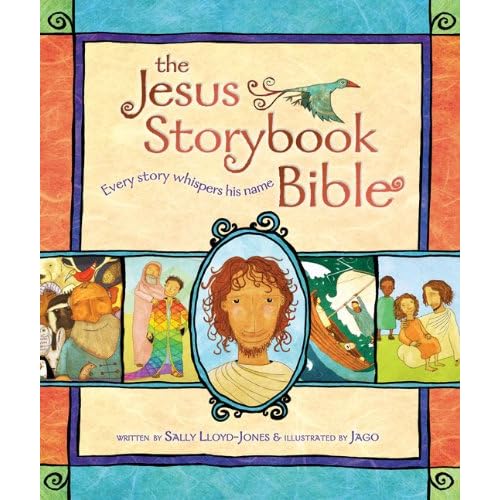
Wesley walked up to me and said, "Jonah was sinking down, down, down..." I guess it is a line from a song or something he has learned. I grabbed the Jesus Storybook Bible and turned to the story about Jonah. We read it, talked about he pictures, and discussed some of his difficult questions (Where's God?).
We thumbed around to Jesus' baptism to talk about where God is, the temptations of Jesus, then looked at which ever pictures that caught his attention.
A couple of observations:
1) When 'teachable' moments come, I need to be ready. That means I might need to stop what I'm doing. It definitely means that I need to be familiar with a good kids Bible and the big truths that aren't so obvious from the pictures (like, Where is God?).
2) Children learn what they hear often. I don't want my son singing Beyonce or Cold Play. I want him singing "I Want to Be Like Jesus" or the thing about Jonah that started our conversation today. I keep meaning to pick up a good baptist catechism so that my son and I can discuss those big ideas, too. Reading him the Bible is indispensable, of course.
Thursday, February 18, 2010
Good Spiritual Warfare intro
Last year my sister recommended Mark Driscoll's 4-part lecture on spiritual warfare. I learned a great deal from it. I'll embed the audio only, but there is video from Mars Hill Church if you want to watch.
They're intense but understandable. Driscoll warns against dabbling in this stuff before you get a good handle on what is at stake. Remember the 7 sons of Sceva from Acts 19:11-17!
They're intense but understandable. Driscoll warns against dabbling in this stuff before you get a good handle on what is at stake. Remember the 7 sons of Sceva from Acts 19:11-17!
Thursday, May 7, 2009
National Day of Prayer
Today is the 58th annual National Day of Prayer, and our small county had about 120 (according to the organizer - thanks, Jon!) participate on the courthouse steps. The organizer assigned me the topic of praying for/about the media (other assigned topics include families, government, business, Church, etc.) I was encouraged to write out the prayer (400-600 words), in order to stay brief and on point. I'd like to share it with you:
King of the ages, we thank you for the media that have served our nation since its beginning. We thank you for the combination of free speech, free press, and free markets in our country. These are big responsibilities for us! There are so many sources of information & entertainment that we’ve suppressed a hunger for wisdom & truth. We joke that we can’t believe everything we see on TV, the Internet, or in the paper, but we just stick to our preferred sources of information and avoid the work of learning truth.
Jesus, you are the Truth. You are real life. The Scriptures you produced are able to make us wise for salvation. The Spirit you give us is the Spirit of wisdom and revelation. May your will be done in studios, press rooms, publishing houses, video conferences and on personal computers across this nation. Please gift your Church with creative & wise people who can model for us how to use all forms of media to spread the gospel and to promote righteousness. If the medium truly is neutral, then the people who are producing the stories, the images, and the music are certainly not. Please send missionaries to infiltrate all forms of media, to call the lead worshipers of our culture’s gods out of idolatry. Journalists, editors, producers, musicians, advertising execs, actors, directors, musicians, and webmasters all need Jesus.
Ruler of all nations,
Wednesday, April 22, 2009
a Prayer from a Single Man
Isaac Watts (1674-1748) is known to me because of his hymns (Joy to the World, When I Survey the Wondrous Cross, etc.). I found a fascinating little story in a short biography.
Watts (a young pastor with an earned doctorate) proposed marriage to Miss Elizabeth Singer; she politely declined. She reflected on her reason by saying of Watts, "I loved the jewel, but I did not admire the casket which contained it." Watts was short (5' 2" at most), not handsome, and often sick. He took this pretty hard, but he wrote a magnificent prayer (reminds me of 1Cor. 7:25-35)
How vain are all things here below!
How false, and yet how fair!
Each pleasure hath its poison too,
and every sweet a snare.
The brightest things below the sky
Give but a flattering light;
We should suspect some danger nigh
Where we possess delight.
Our dearest joys, and nearest friends,
The partners of our blood,
How they divide our wavering minds,
And leave but half for God!
The fondness of a creature's love,
How strong it strikes the sense!
Thither the warm affections move,
Nor can we call them thence.
Dear Saviour, let Thy beauties be
My soul's eternal food;
And grace command my heart away
From all created good.
Watts (a young pastor with an earned doctorate) proposed marriage to Miss Elizabeth Singer; she politely declined. She reflected on her reason by saying of Watts, "I loved the jewel, but I did not admire the casket which contained it." Watts was short (5' 2" at most), not handsome, and often sick. He took this pretty hard, but he wrote a magnificent prayer (reminds me of 1Cor. 7:25-35)
How vain are all things here below!
How false, and yet how fair!
Each pleasure hath its poison too,
and every sweet a snare.
The brightest things below the sky
Give but a flattering light;
We should suspect some danger nigh
Where we possess delight.
Our dearest joys, and nearest friends,
The partners of our blood,
How they divide our wavering minds,
And leave but half for God!
The fondness of a creature's love,
How strong it strikes the sense!
Thither the warm affections move,
Nor can we call them thence.
Dear Saviour, let Thy beauties be
My soul's eternal food;
And grace command my heart away
From all created good.
Sunday, April 19, 2009
a Missionary Command

These are the 3 martyrs from Malatya, Turkey of April 18, 2007.
This morning I taught on Matt. 5:43-48 - Jesus' famous command to "love your enemies." I think it only makes sense if we hold it together with: (1) Jesus' commission to his followers to spread the gospel and (2) Jesus' prediction that his followers will face opposition because of Him.
Putting this into a single directive: "As you proclaim the gospel and call on all kinds of people to repent, you will find many who push back at you - love those people. Welcome them with the same kindness your Creator & Judge showered on you while you were his enemies."
"Love your enemies" is a missionary command.
Tuesday, March 3, 2009
Bible Reading

 I posted many months ago that Wesley & I try to keep up with the ESV Daily Reading Bible; the three latest days are always on the upper right of this blog. Last year, we read through the Old Testament including Psalms for the first six months and the other part of the Old Testament (minus Psalms) with the New Testament in the second six months. So, all in all, we made it through the whole Bible last year. I did read the Song of Songs to myself instead of sharing it with Wesley.
My offer still stands from long ago: if you are reading in your Bible or reading along with the Daily Reading Bible, please feel free to post your comments/questions about a passage on any of our posts. I would be glad to moderate a discussion on any subject raised by Scripture (particularly as things arise in your reading/study times).
A great resource is available online for the month of March: the entirety of the new English Standard Version Study Bible. All you need to do is enter your email address and create a password. You might want to buy the thing after trying the online version! It has great maps, plenty of commentary on all parts of the Bible, and dozens of articles that help piece together the themes of the Bible, the historical background to events recorded in the Bible, the history of the biblical text, as well as many articles on interpreting and applying the Bible to your life.
I tried to include a cool image of what the tabernacle might have looked like, but it was too detailed to fit a reasonable size in here. Just sign up for the free month and look at the incredible diagrams, articles, and maps!
HT: JT
Wednesday, February 25, 2009
Knowing God's Will for Me
I just emailed a friend about figuring out what God wants us to do in life. I think there are two (complementary) ways to approach knowing God's will. I'll share:
existential (aka "subjective") - It comes down to *confidence* based on some thought, some dream, some godly desire or passion that drives what you do and where you go. I think it overstatement to say such "feelings" are always or even usually the Spirit of Christ; but he's with us and he has a personal influence on us. Maybe his influence comes to our awareness (1) by using our personality & already conscious inclinations, and other times (2) by introducing new or foreign ideas/desires.
inductive (aka "logical") - This is theological work combined with honest, personal reflection. Scripture tells us that God expects _(fill in the blank)_ of me; am I becoming such a person? Am I doing those things "heartily, as unto the Lord" himself? Going through a list of God's revealed expectations for a man in my situation with my responsibilities can establish parameters - "fences, goads, and rewards along God's path for me" - that can show me I probably am OR certainly am not walking down God's path for my life.
If I am inside the revealed parameters ("fences, goads & rewards") God has revealed in Scripture for someone in my situation, then I can assure my restless mind that my Shepherd will not let me wander so far off course as to miss his specific plans for my life. He's too kind to conscience such a thing.
Unfulfilled dreams, desires, passions, directions from others, etc. might be Jesus' voice leading us into a new path, but they should not become barbs and thorns that stick in our hearts to make us suspect that we've missed God's plan for us. Maybe even I made some promise in my past about what I would do or become - a promise that would cause me to hop the fence, kick against the goads, or ignore God's rewards. Jephthah (Judges 11) was not honorable for keeping his foolish vow to the Lord.
Those unfulfilled motivators might be to prepare me to see and pursue future opportunities the Shepherd has planned. If those unfulfilled motivators have me wondering about the past only ("What if I had..."), I might need to let them die, so that I can live and prepare for what's ahead.
Remember, Jesus is kind. He loves us better than and prior to any of our loves. Who can be against us?
What do you (our illustrious 3 readers) think?
existential (aka "subjective") - It comes down to *confidence* based on some thought, some dream, some godly desire or passion that drives what you do and where you go. I think it overstatement to say such "feelings" are always or even usually the Spirit of Christ; but he's with us and he has a personal influence on us. Maybe his influence comes to our awareness (1) by using our personality & already conscious inclinations, and other times (2) by introducing new or foreign ideas/desires.
inductive (aka "logical") - This is theological work combined with honest, personal reflection. Scripture tells us that God expects _(fill in the blank)_ of me; am I becoming such a person? Am I doing those things "heartily, as unto the Lord" himself? Going through a list of God's revealed expectations for a man in my situation with my responsibilities can establish parameters - "fences, goads, and rewards along God's path for me" - that can show me I probably am OR certainly am not walking down God's path for my life.
If I am inside the revealed parameters ("fences, goads & rewards") God has revealed in Scripture for someone in my situation, then I can assure my restless mind that my Shepherd will not let me wander so far off course as to miss his specific plans for my life. He's too kind to conscience such a thing.
Unfulfilled dreams, desires, passions, directions from others, etc. might be Jesus' voice leading us into a new path, but they should not become barbs and thorns that stick in our hearts to make us suspect that we've missed God's plan for us. Maybe even I made some promise in my past about what I would do or become - a promise that would cause me to hop the fence, kick against the goads, or ignore God's rewards. Jephthah (Judges 11) was not honorable for keeping his foolish vow to the Lord.
Those unfulfilled motivators might be to prepare me to see and pursue future opportunities the Shepherd has planned. If those unfulfilled motivators have me wondering about the past only ("What if I had..."), I might need to let them die, so that I can live and prepare for what's ahead.
Remember, Jesus is kind. He loves us better than and prior to any of our loves. Who can be against us?
What do you (our illustrious 3 readers) think?
Friday, February 20, 2009
Logic and the Economic Crisis
The current downturn (don't read depression yet) in our economy provides a great example of an unfortunate "principle" for human beings: If the right people (or enough people) say the same thing long enough, we will believe it.
Thomas Sowell summarizes how this has transpired:
I am intending to offer a crash course on basic logic (informal fallacies are the fun part) for my church folk. We'll look at some examples from misguided economic & political ideals.
HT: Matt Perman
Thomas Sowell summarizes how this has transpired:
From television specials to newspaper editorials, the media are pushing the idea that current economic problems were caused by the market and that only the government can rescue us.What was lacking in the housing market, they say, was government regulation of the market's "greed." That makes great moral melodrama, but it turns the facts upside down.
It was precisely government intervention which turned a thriving industry into a basket case.
Sowell goes on to explain (the whole piece is 2 pages) that government intervention was a primary cause, and government intervention (such as the stimulus) probably will not help the recovery.
I am intending to offer a crash course on basic logic (informal fallacies are the fun part) for my church folk. We'll look at some examples from misguided economic & political ideals.
HT: Matt Perman
Wednesday, August 20, 2008
Advice for Young Adults
Listen to people's advice, evaluate the content, and apply everything that's good.
I've received plenty of advice in my few years. Even though I am a leader in a church, I still receive condescending advice decently well. Yet sometimes people get to me, exposing my pride by giving me advice I don't want or advice I don't want to receive from those particular people.
This attitude has the potential to disqualify me from leadership in the church. Paul's regulations for overseers in the church at Ephesus included this: "He must not be a new convert, lest he become puffed up [with pride], leading to the [same] condemnation experienced by the devil [i.e., for pride]" (1 Timothy 3:6).
Refusal to receive advice is a mark of pride. It is particularly common in younger people, well-educated people, and people accustomed to high positions.
Don't get offended by condescension. Listen for truth and appreciate people - even if they don't express themselves in a refreshing manner. Don't fall into the same condemnation the devil received. God opposes me when I'm proud.
I've received plenty of advice in my few years. Even though I am a leader in a church, I still receive condescending advice decently well. Yet sometimes people get to me, exposing my pride by giving me advice I don't want or advice I don't want to receive from those particular people.
This attitude has the potential to disqualify me from leadership in the church. Paul's regulations for overseers in the church at Ephesus included this: "He must not be a new convert, lest he become puffed up [with pride], leading to the [same] condemnation experienced by the devil [i.e., for pride]" (1 Timothy 3:6).
Refusal to receive advice is a mark of pride. It is particularly common in younger people, well-educated people, and people accustomed to high positions.
Don't get offended by condescension. Listen for truth and appreciate people - even if they don't express themselves in a refreshing manner. Don't fall into the same condemnation the devil received. God opposes me when I'm proud.
Tuesday, January 22, 2008
The Tough Issue of Global Warming
This post makes me a bit nervous because I know that the global warming discussion rarely proceeds untethered to other political, moral and religious views. Or to say it differently, who can discuss this current issue without personal bias or unfairly caricaturing opposing views and their proponents?
If you want to get to my point, skip all this smaller type and follow the links to Paul Helm's two Analyses (#9 and #10)
Here is my dilemma: I have two relatives who have vastly greater understanding of the issue than I do (both with PhD's in the "hard" sciences) and much keener interest in the issue than I have. These two men have never (to my knowledge) met in person. As I understand each one's position on Global Warming, the two views are quite divergent - almost diametrically opposite! And both can be pretty passionate and persuasive (I must take them according to their authority to address the subject - not on their use of the evidence because I can't make sense of the hard data). What am I to think or to do?
I have my political leanings (I just preached Sunday from Genesis 1 that God is Pro-Life; this is one of the most important issues in politics today because I think abortion, euthanasia, embryonic stem cell research, etc., seem to be arbitrary suspensions of the "all men are created equal and are endowed with certain, inalienable rights" idea at the base of our country's government), but that should not ruin a fair evaluation.
Please read these two analyses by Paul Helm (a British, Christian philosopher) and post a thought or two. He doesn't have an editor, it seems, so look past the mistakes.
First part:
http://paulhelmsdeep.blogspot.com/2007/12/analysis-9-saving-planet-whats-best-bet.html#links
Second part:
http://paulhelmsdeep.blogspot.com/2008/01/analysis-10-saving-planet-whats-stake.html#links
I welcome your comments and discussion!
Saturday, November 17, 2007
Suggested Reading

At a conference in 2006, I received a paperback Bible with a yearly reading plan in it. At the time, I was in the habit of slower, more deliberate Bible reading. I took the chance on the reading plan, and I have thoroughly enjoyed it for 18 months or so. This summer I found that Crossway Books/Good News Publishers has the reading plan available online for free. I quickly gave my hard copy to a student (whom I hope is using it). The ESV site has nice search features as well as the audio of the entire Bible - read by a nice, rich-voiced Brit.
I just figured out what an RSS feed was, so I thought I would put it here (top right corner) for both of you who check our blog more than once a week. Now you know (some of) what Wesley and I are reading. We're a couple of days behind in the plan, and we are only reading the Old Testament and Psalms right now (because that is how I've used the reading plan on my own). I decided that I could either separate my personal pursuit of God from time with my son, or I could bring him along on the journey. The second made more sense. I can't wait until he begins asking questions! In the mean time, he will not (nor will I) understand everything. We are finishing up the judgments against the nations at the end of Jeremiah, so I tell him basic truths about God's position as Judge of his Creation. "We must each answer to our Creator for how we have lived." I'm hoping the good news about the Savior who died as a Substitute for us will make sense to him at a young age!
One other thing - because I want to encourage you who read this blog to get better acquainted with the God of the Bible, I'll make a standing offer: if you try out the daily reading chapters and want to discuss them or if you would like tips for benefiting from what you read, just put a comment on one of our posts - or email me/Laura if you like. You might have an idea I've never had, you might not agree with my idea, or we might all be stumped by some of the things written. But I guarantee that each of us will profit by attending a bit more to the Bible.
Wednesday, November 14, 2007
Let my people...work?
In our small church I (among other responsibilities) lead a class for the broad category "young adults." Though most of our gatherings have been devoted to covering the biblical basis for major points of the Christian faith ("doctrines" for you initiates) and a survey of the Old Testament (two of our weaker points in most evangelical churches), I took a deviation this last Sunday. We looked at what the Bible says about work.
Why do we work? If our best answer is "to provide for ourselves and our families," we have a strong motivator. Proverbs 16 calls this wisdom: "A worker's appetite works for him;his mouth urges him on." (ESV) What if you are "set for life" or retired? What if you have someone else who supplies all you need? If you have no need for gainful employment does that mean you have no need or responsibility to work? Is work a curse from which the wealthy and dependents can and should escape?
No. Genesis 1 and 2 describe work as part of God's perfect design for mankind in his responsibility to God. God's command in Genesis 1 to "be fruitful, multiply, fill the earth and subdue it, and have dominion over..." creation was not an endorsement of exploiting creation! It was a command to fill the earth with families and larger networks of relationships necessary to cultivate order and beneficial structure. With all that is involved in God's design (like the norms of heterosexual marriage and parenting) the normativity of work is certainly a part. Valuable work according to God's design need not be remunerative; in fact, raising children is clearly one of the most important and most demanding tasks the Bible assigns us (something Laura and I do free of charge).
Since work was part of God's design for mankind before sin, and since our (i.e., only those who "belong to Christ at his coming") eternal home will be in the New Creation (an embodied existence without the curse of sin and death), I fully expect we will work as we worship King Jesus. So, I think work is part of our design.
But then there are some interesting practical directives about work in Paul's letters. In 1 Timothy 5, while giving instructions for how churches should care for widows, Paul clearly commands that children and grandchildren care for widowed elderly relatives. Not to do so is tantamount to denying the Christian faith. Paul even seems to suggest that next of kin should always feel responsibility for elderly widows.
This has practical implications for people my age. Grandparents and parents, maybe even aunts and uncles, need to be among our reasons for working for pay. Or maybe the way to please God will be to be the primary care provider or just a roommate for an elderly relative. We need to be ready to "make a return."
One last thing about work, especially for pay: "Let the thief no longer steal, but rather let him labor, doing honest work with his own hands, so that he may have something to share with anyone in need." (Eph. 4:28 ESV) Theft is the opposite of how Christians should handle possessions, but most of us aren't "into" theft. Still, we work mostly for ourselves (sort of in the middle of this command) when we should work hard so that we might have something to share with anyone in need. Imagine the force of generosity that would be released on this world if Christians in the US worked hard, saved aggressively - not to raise our standard of living - but to give toward all sorts of worthy causes (most supremely, in my mind, Christian missions)!
There is more to be said about work as Christians, but there is also much to be said about rest and caring for one's body, so I'm off to bed.
Why do we work? If our best answer is "to provide for ourselves and our families," we have a strong motivator. Proverbs 16 calls this wisdom: "A worker's appetite works for him;his mouth urges him on." (ESV) What if you are "set for life" or retired? What if you have someone else who supplies all you need? If you have no need for gainful employment does that mean you have no need or responsibility to work? Is work a curse from which the wealthy and dependents can and should escape?
No. Genesis 1 and 2 describe work as part of God's perfect design for mankind in his responsibility to God. God's command in Genesis 1 to "be fruitful, multiply, fill the earth and subdue it, and have dominion over..." creation was not an endorsement of exploiting creation! It was a command to fill the earth with families and larger networks of relationships necessary to cultivate order and beneficial structure. With all that is involved in God's design (like the norms of heterosexual marriage and parenting) the normativity of work is certainly a part. Valuable work according to God's design need not be remunerative; in fact, raising children is clearly one of the most important and most demanding tasks the Bible assigns us (something Laura and I do free of charge).
Since work was part of God's design for mankind before sin, and since our (i.e., only those who "belong to Christ at his coming") eternal home will be in the New Creation (an embodied existence without the curse of sin and death), I fully expect we will work as we worship King Jesus. So, I think work is part of our design.
But then there are some interesting practical directives about work in Paul's letters. In 1 Timothy 5, while giving instructions for how churches should care for widows, Paul clearly commands that children and grandchildren care for widowed elderly relatives. Not to do so is tantamount to denying the Christian faith. Paul even seems to suggest that next of kin should always feel responsibility for elderly widows.
This has practical implications for people my age. Grandparents and parents, maybe even aunts and uncles, need to be among our reasons for working for pay. Or maybe the way to please God will be to be the primary care provider or just a roommate for an elderly relative. We need to be ready to "make a return."
One last thing about work, especially for pay: "Let the thief no longer steal, but rather let him labor, doing honest work with his own hands, so that he may have something to share with anyone in need." (Eph. 4:28 ESV) Theft is the opposite of how Christians should handle possessions, but most of us aren't "into" theft. Still, we work mostly for ourselves (sort of in the middle of this command) when we should work hard so that we might have something to share with anyone in need. Imagine the force of generosity that would be released on this world if Christians in the US worked hard, saved aggressively - not to raise our standard of living - but to give toward all sorts of worthy causes (most supremely, in my mind, Christian missions)!
There is more to be said about work as Christians, but there is also much to be said about rest and caring for one's body, so I'm off to bed.
Subscribe to:
Posts (Atom)